01
取邻居光线Neighbour rays
- \(\mathbf p=(x,y)\)
- 像素中心。The pixel centre.
- \(\boldsymbol\Delta_x=(\tfrac12,0),\ \boldsymbol\Delta_y=(0,\tfrac12)\)
- 半像素偏移,指向像素两条边的中点。Half-pixel offsets to the midpoints of two pixel edges.
- \(\Pi^{-1}\)
- 相机的反投影:把像素坐标变成世界坐标系下的单位光线方向。针孔和鱼眼只有这一项不同。The camera's inverse projection: pixel coordinates to a unit ray direction in world coordinates. Pinhole and fisheye differ only here.
- \(\mathbf o\)
- 相机光心,所有光线的起点。The optical centre, where every ray starts.
- \(\mathbf d=\Pi^{-1}(\mathbf p)\)
- 中心光线的方向。Direction of the centre ray.
- \(\mathbf d_i=\Pi^{-1}(\mathbf p+\boldsymbol\Delta_i),\ i\in\{x,y\}\)
- 两条边缘光线,和 d 来自同一个相机模型。The two edge rays, from the same camera model as d.
假设 1(局部线性):像素内的光线方向场近似线性,所以一个像素的光线束截面是平行四边形。Assumption 1 (local ray-linearity): the ray-direction field is locally linear within a pixel, so the cross-section of its bundle is a parallelogram.
02
搬到最大响应深度 t*Transport to t*
- \(\boldsymbol\mu,\ \boldsymbol\Sigma=\mathbf R\mathbf S^2\mathbf R^{\top}\)
- Gaussian 的均值和协方差;R 是旋转,S = diag(s₁, s₂, s₃) 是三个轴的尺度。The Gaussian's mean and covariance; R is its rotation, S = diag(s₁, s₂, s₃) its axis scales.
- \(\mathbf W=\mathbf S^{-1}\mathbf R^{\top}\)
- 白化变换:把这个 Gaussian 变成单位各向同性球。Whitening: maps this Gaussian to the unit isotropic ball.
- \(\mathbf d_u=\mathbf W\mathbf d,\ \ \mathbf o_u=\mathbf W(\mathbf o-\boldsymbol\mu)\)
- 白化空间里的光线方向和起点。Ray direction and origin in the whitened space.
- \(t^\ast=-\langle\mathbf o_u,\mathbf d_u\rangle/\lVert\mathbf d_u\rVert^2\)
- 光线参数:沿这条光线 Gaussian 响应最大的位置。The ray parameter where the Gaussian responds most along the ray.
- \(\mathbf M_{\!\perp}=\mathbf I-\mathbf d_u\mathbf d_u^{\top}/(\mathbf d_u^{\top}\mathbf d_u)\)
- 投影到与白化光线垂直的平面(光线垂直平面)。Orthogonal projector onto the plane perpendicular to the whitened ray (the ray-orthogonal plane).
- \(\mathbf e_i=t^\ast\,\mathbf M_{\!\perp}\mathbf W(\mathbf d_i-\mathbf d)\)
- 白化并投影后的半边向量。乘 t* 是因为 footprint 随距离线性变大。Whitened, projected half-edge vectors. The factor t* makes the footprint grow linearly with distance.
假设 2(深度局部性):在 Gaussian 的有效积分范围内 footprint 变化很小,所以只在 t* 处取一次截面。Assumption 2 (depth locality): the footprint changes little over the Gaussian's effective integration range, so it is taken once, at t*.
03
白化 + 矩匹配Whiten + moment-match
- \(\Omega_{\rm fp}^{u}=\{a\,\mathbf e_x+b\,\mathbf e_y\mid a,b\in[-1,1]\}\)
- 白化空间里像素截面的平行四边形。The pixel's cross-section parallelogram in the whitened space.
- \(\tfrac13\)
- [−1, 1] 上均匀分布的方差。Variance of a uniform variable on [−1, 1].
- \(\boldsymbol\Sigma_{\rm fp}=\tfrac13(\mathbf e_x\mathbf e_x^{\top}+\mathbf e_y\mathbf e_y^{\top})\)
- 平行四边形上均匀分布的协方差,即 footprint 协方差(论文中记作 Σfpu),均值为 0。Covariance of the uniform distribution over the parallelogram: the footprint covariance (Σfpu in the paper), with zero mean.
- \(\boldsymbol\Sigma_{\rm fp}\,\mathbf d_u=\mathbf 0\)
- 它完全落在光线垂直平面内,秩为 2。It lies entirely in the ray-orthogonal plane (rank 2).
假设 3(矩匹配):用同均值、同协方差的 Gaussian 代替平行四边形上的均匀核,卷积就变成协方差相加。Assumption 3 (moment matching): the uniform kernel over the parallelogram is replaced by the Gaussian with the same mean and covariance, so convolution becomes a covariance sum.
04
闭式响应Closed-form response
- \(\sigma\)
- Gaussian 的不透明度。The Gaussian's opacity.
- \(\mathbf q=\mathbf M_{\!\perp}\mathbf o_u\)
- 从 Gaussian 中心指向光线最近点的向量(白化空间,垂直于光线)。Vector from the Gaussian centre to the ray's closest point (whitened, perpendicular to the ray).
- \(D^2=\lVert\mathbf q\rVert^2\)
- 光线到 Gaussian 中心的最小平方 Mahalanobis 距离。Minimum squared Mahalanobis distance from the ray to the Gaussian centre.
- \(\mathbf A=\mathbf I+\boldsymbol\Sigma_{\rm fp}\)
- 滤波后白化 Gaussian 的协方差:单位 Gaussian 与 footprint Gaussian 卷积,协方差相加。Filtered covariance of the whitened Gaussian: convolving the unit Gaussian with the footprint Gaussian adds the covariances.
- \(1/\sqrt{\det\mathbf A}\)
- 卷积带来的归一化,保持响应的总量不变。Normalisation from the convolution; it keeps the total response unchanged.
- \(T\)
- 这个像素对这个 Gaussian 的滤波响应。This pixel's filtered response to this Gaussian.
Σfp → 0(像素无限小)时 A → I,T 退化为单条中心光线的响应 \(\sigma e^{-D^2/2}\)。A 沿 du 方向不变,所以不必显式建立平面坐标系。As Σfp → 0 (an infinitesimal pixel), A → I and T reduces to the single centre-ray response \(\sigma e^{-D^2/2}\). A is unchanged along du, so no explicit plane basis is needed.
 ConeGaussian
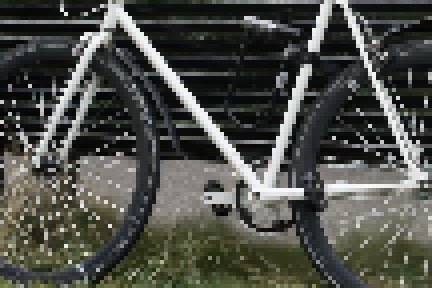

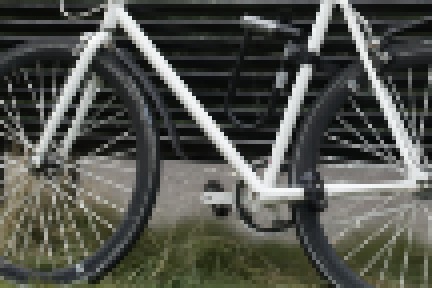
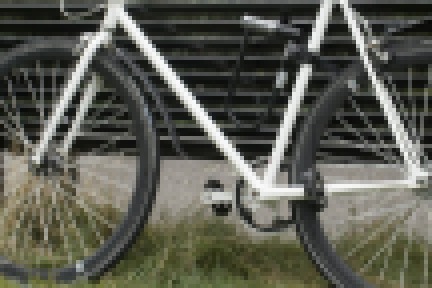 3DGEERConeGaussian真值 GTGround truth