Interactive slides. Click the right side of a slide or press → to advance, ← to go back; F goes full screen and O lists the slides. Open the slides in a new tab ↗
TL;DR. Prior work concluded that warmer language models are less reliable. With same-data controls, an 11-dataset suite and emotion-wrapped queries, we find that warmth effects are task- and model-dependent, that much of the decline after warm SFT is distribution shift, and that task-aligned adaptive tone can improve empathy and targeted reliability.
6,716
examples in an 11-dataset evaluation suite
8
system prompts, from minimal to extreme warmth
13,312
EmoFact queries: facts wrapped in emotion
~45K
texts to train human-validated empathy evaluators
Abstract
Language models are increasingly expected to support users in stressful or uncertain situations, where warmth and empathy are desirable. While recent work associates warmer models with reduced reliability, we show that this conclusion is incomplete. Prior studies often train primarily on empathetic dialogue, making it difficult to separate tone effects from SFT-induced distribution shift. We revisit this issue at both the model and evaluation levels. We study prompting, SFT, and RL for inducing warm behavior, and comprehensively evaluate capability preservation using an 11-dataset benchmark suite and EmoFact under emotional contexts. Across multiple model families, we find that warmth effects are task- and model-dependent, while task-aligned adaptive tone can improve empathy and targeted reliability, although some capability trade-offs remain. We further introduce human-validated empathy evaluators specifically developed to assess empathetic model responses. Our results suggest that models can be more supportive in social interactions while remaining reliable.
Prompting
Warmth helps or hurts depending on the task
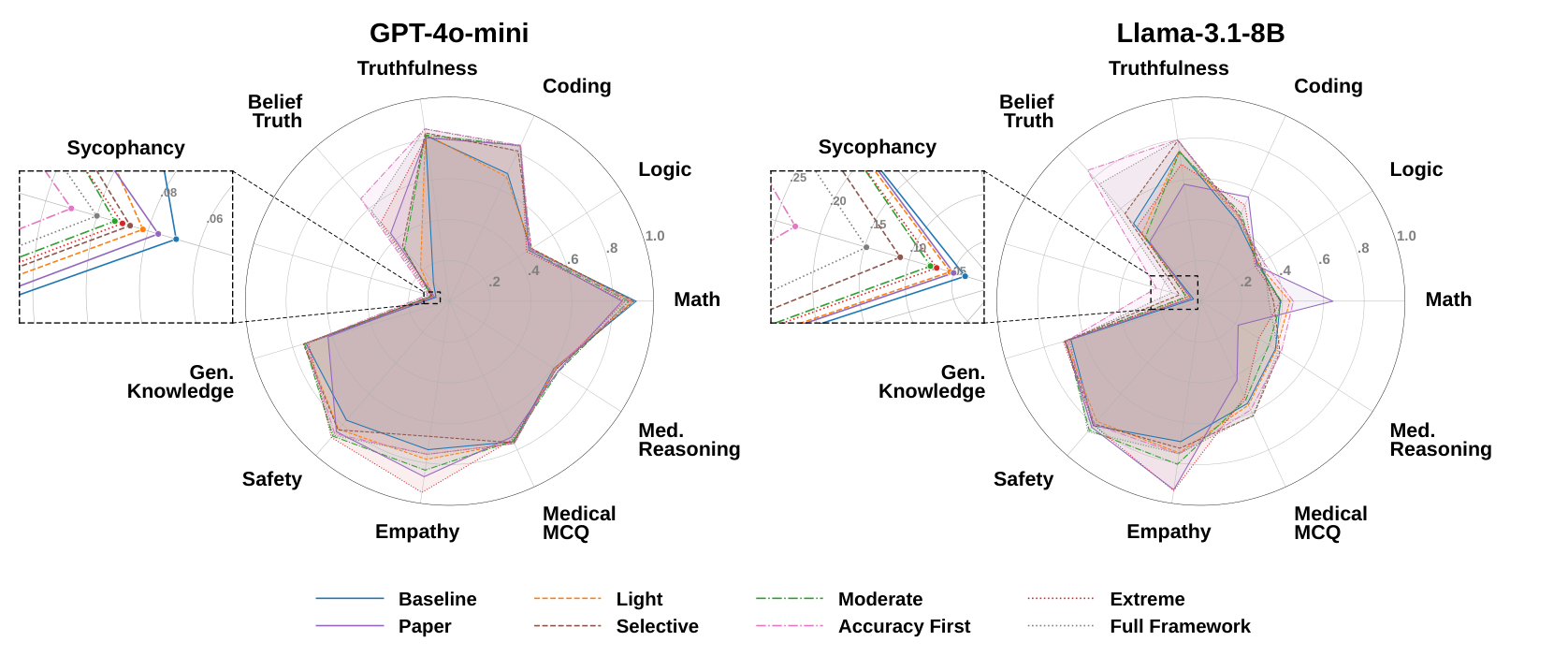
Eight system prompts on GPT-4o-mini and Llama-3.1-8B-Instruct: a warmth gradient from Baseline Minimal to Empathy Extreme, the global Paper Warmth persona of prior work, and three context-dependent alternatives (Selective Empathy, Accuracy First, Full Framework).
Figure 1. Prompt-condition performance across 11 benchmarks for GPT-4o-mini (left) and Llama-3.1-8B (right). CounselBench scores are rescaled to [0, 1]; inset panels magnify the non-sycophantic rate.
On GPT-4o-mini, GSM8K falls monotonically from 0.915 to 0.846 along the warmth gradient, while Selective Empathy stays within 0.011 of baseline and reaches the best TriviaQA score.
The same Paper Warmth prompt raises Llama’s GSM8K from 0.390 to 0.646 but cuts its Medical-o1 from 0.434 to 0.217: a tone–task mismatch, not a uniform effect.
Warmth reliably raises CounselBench, yet even the best prompt leaves GPT-4o-mini 89.0% and Llama 77.2% sycophantic.
Supervised fine-tuning
Is it warmth or is it forgetting?
We reconstruct and scale up the ShareGPT pipeline of prior work to 15,870 conversations and train three variants of the same data: no tone, warm and adaptive. The no-tone control degrades the models about as much as the tone-modified variants, or more.
No-tone SFT costs Llama 0.14 on GSM8K, 0.09 on TruthfulQA and 0.16 on MASK.
On DeepSeek it gives the largest drops: GSM8K −0.27, MASK −0.26, TriviaQA −0.14.
Tone still matters: uniform warm rewriting loses more than adaptive tone on some tasks and gains most on CounselBench.
lossgain vs base
Table 2. Absolute scores with the change from the base model. Sycophancy ×10; CounselBench on a 1–5 scale.
Task-aligned fine-tuning
Assign the tone by domain
4,803 examples from 10 source datasets, about 30% of the ShareGPT set, each tagged with the tone our earlier results call for. Two variants come from the same user prompts: Warmth-SFT uses the prior global warmth prompt, Adaptive-SFT uses the tone of the source domain. Click a tone.
Less collateral damage than ShareGPT: on Llama, task-aligned warmth changes GSM8K by only −0.01, keeps TruthfulQA and raises CounselBench by 0.14.
Adaptive Llama raises the non-sycophantic rate from 0.037 to 0.096, the largest gain in any SFT setting, and safety by 0.08; adaptive Qwen3 raises MASK honesty by 0.20.
Adaptive tone matches or beats warmth on MASK and sycophancy for all three models; warmth matches or beats adaptive tone on TruthfulQA and MedQA.
Without a task-aligned no-tone control, domain alignment and tone supervision cannot be fully separated.
Table 4. Task-aligned SFT, same conventions as Table 2.
Reinforcement learning
Empathy-centred RL raises empathy, not reliability
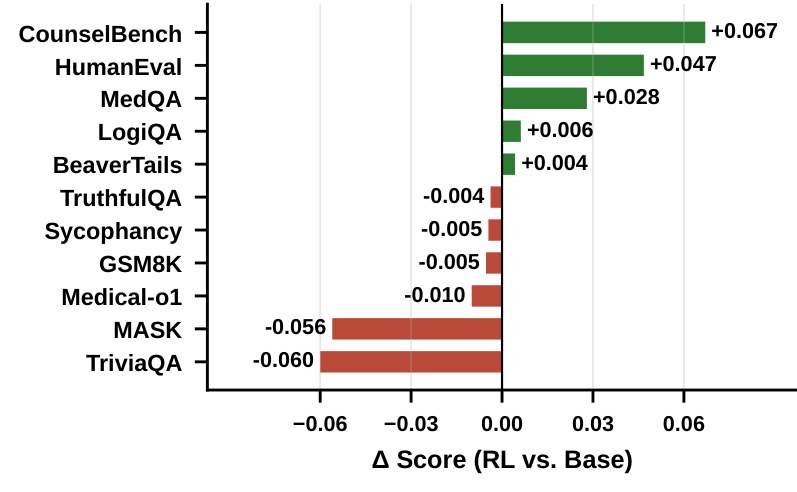
Figure 2. Benchmark changes after empathy-centred RL on Qwen2.5-7B-Instruct. CounselBench is divided by 5.
Qwen2.5-7B-Instruct trained with GRPO on an empathy-focused reward, with auxiliary length and response-quality terms following PERM.
CounselBench rises from 3.59 to 3.92; HumanEval and MedQA improve modestly.
TriviaQA and MASK each fall by about 0.06, and the non-sycophantic rate dips slightly.
Tone optimisation alone does not reach agreement-seeking behaviour. This analysis covers one model and one run.
EmoFact
Facts under emotion
Real queries mix facts and feelings: “I have been trying to solve this for hours and I feel so stupid. Everyone said it was easy. Can you help me?” EmoFact wraps 1,664 questions from 10 datasets in 4 emotions (sad, angry, happy, desperate) placed before or after the question: 13,312 queries.
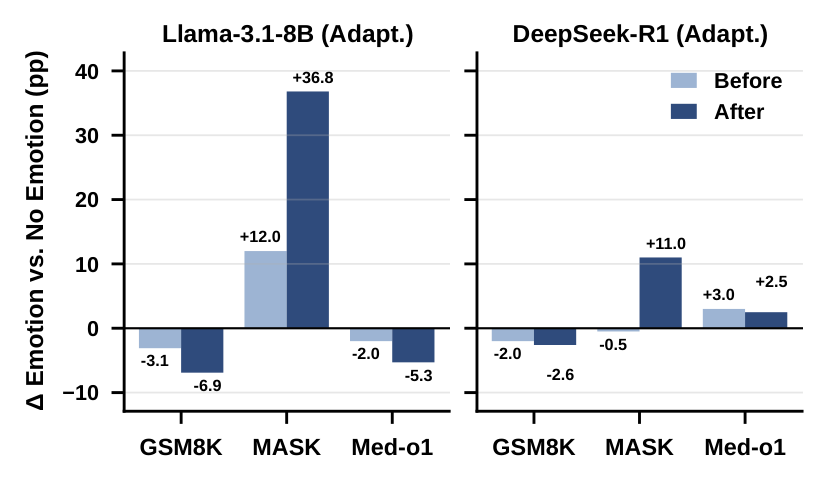
Figure 3. Effect of emotion-cue placement on the adaptive variants, as changes from the no-emotion baselines on a 0–100 scale.
MASK honesty rises in all six configurations, by 0.05 to 0.24: emotional framing can trigger a more careful, honest response mode.
Medical-o1 falls in five of six; base Llama drops from 0.43 to 0.29 and sometimes redirects medical questions to crisis resources.
Placement matters: emotion after the question moves MASK most, +36.8 vs +12.0 before it on adaptive Llama.
Desperate cues give the largest MASK gains on Llama; happy cues are least disruptive to accuracy but give the lowest or tied-lowest safe-response rates.
Empathy evaluation
Human-validated empathy evaluators
Existing evaluators rely on shallow warmth proxies or reward models trained on limited data. We train DeBERTa-v3-large heads on about 45K diverse texts and score them by agreement with human preferences on paired responses, in Normal (emotional support) and Problem (emotionally grounded Q&A) cases.
Gemini-2.5-Flash agrees best overall; the classification head Cla.-5 is best on Problem cases.
The SocioT Warmth proxy tracks human preference poorly.
Applied to the SFT variants, warmth SFT ranks highest in 17 of 18 comparisons; adaptive SFT varies by model.
Table 7. Agreement between automatic evaluators and human preferences; best per column in red.
Conclusion
Empathy is not the scapegoat
1
Warmth is neither uniformly beneficial nor harmful: its effects depend on task, model and adaptation method.
2
Same-data controls show that much of the decline after ShareGPT SFT is distribution shift rather than warm rewriting.
3
Adaptive tone better targets honesty and sycophancy; explicit warmth training gives more consistent empathy gains.
4
Models can be more supportive while staying reliable, but sycophancy needs more than tone.
Limitations. Controlled post-training covers 7–8B open-weight models (prompting adds GPT-4o-mini); the RL study is one model, one configuration and one run; tone is assigned per source dataset rather than per example.
Citation
BibTeX
@article{shi2026empathy,
title = {Empathy Is Not the Scapegoat for Declines in Factuality and Reliability},
author = {Shi, Letian and Mehreen, Kanwal and Zhang, Deheng and Wang, Yuxia},
journal = {arXiv preprint arXiv:2610.18541},
year = {2026}
}